 Ting Chen
Quick Overview
I've been guiding groups through Dukezong for years. And honestly? The first time I walked in without a map, I got tangled in those winding alleys for an hour. The cobblestone paths all look the same, and the maze-like layout can swallow your sense of direction. Google Maps? Useless here. Let me save you the headache.
This guide is built from real experience—walking every lane, testing every shortcut, and noting the exact spots where tourists get lost. By the end, you'll have a mental map that works even without your phone.
Why You Need a Map for Dukezong Ancient Town
The old town is a labyrinth designed without a grid. Unlike Beijing's hutongs or Xi'an's walled city, Dukezong was built by Tibetan and Naxi traders over centuries. The streets branch off unpredictably, and many alleys dead-end at private homes. Without a clear route, you'll waste time backtracking or miss hidden treasures.
Most visitors rely on their phones, but here's the catch: Google Maps is blocked in China, and even with a VPN, its data for Dukezong is outdated. Apple Maps works better but still shows only major roads. The real problem? The town sits on a hill, and the steep shortcuts don't appear on any digital map. I once watched a couple follow Apple Maps straight into a construction site.
How to Navigate: Maps & Tools
Offline Maps: The Lifesaver
Before you arrive, download the offline map of Shangri-La in Baidu Maps (Baidu Ditu) or Alipay's AMap Global. Both are accurate for walking in Dukezong. Launch the app, zoom into the old town area, and download the offline tile (select "Tibet-Sichuan-Yunnan" region). The interface is in Chinese, but you can point to the screen to ask locals. Pro tip: take a screenshot of the main square (Square of the Sun & Moon) – it's the central landmark.
Physical Map: Where to Get One
The tourist information center at the south entrance (Dukezong Ancient Town South Gate) offers free paper maps. Grab one immediately. They're in Chinese and English, though the English is poorly translated. I always bring my own highlighter and mark the must-see spots. Also, many hotels provide a simple hand-drawn map—ask your receptionist.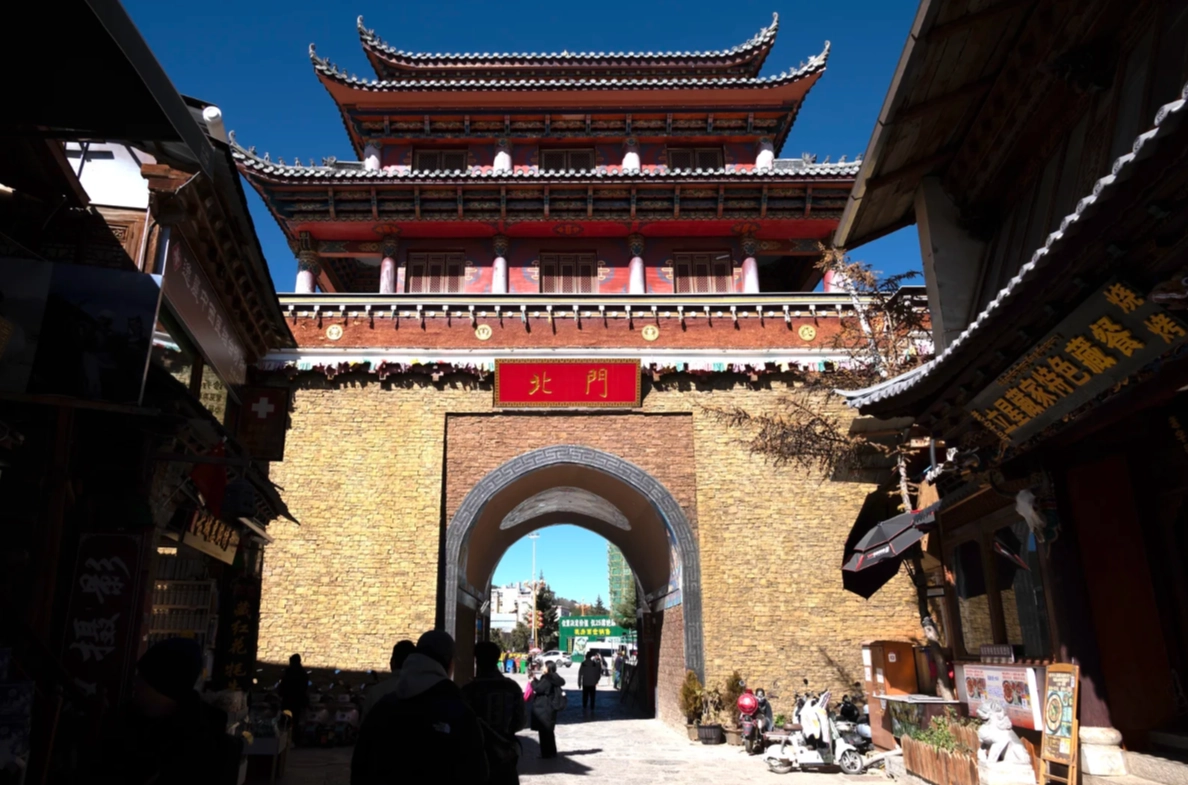
Navigation Signs
Look for the brown bilingual signposts at intersections. They show direction to major attractions like Guishan Hill, Dafo Temple, and the White Pagoda. However, the signs are placed irregularly; sometimes you'll walk five minutes without one. When lost, follow the sound of prayer wheels or the smell of yak butter tea—they lead to the main square.
Key Landmarks & Their Locations
| Landmark | Description | Location / How to Find | Best Time to Visit |
|---|---|---|---|
| Square of the Sun & Moon | The central square with a giant prayer wheel | Heart of the old town; all alleys converge here | Morning (8–10am) for fewer crowds; sunset for photos |
| Guishan Hill | Hill with the world's largest prayer wheel | East side of the square; climb 108 steps | Early morning or late afternoon; avoid midday heat |
| Dafo Temple | Tibetan Buddhist temple with golden roof | Northwest of the square, up the stone staircase | Before 11am (opens at 8am) |
| White Pagoda | Small stupa surrounded by prayer flags | Southwest corner, near the city wall | Any time; best for quiet reflection |
| Old City Wall | Remaining section of the ancient wall | Southern edge, near south gate | Late afternoon for golden light |
Best Walking Route (1–2 Hours)
This is the loop I take every group: efficient, scenic, and avoids crowds. Start at the South Gate, where most buses drop off. Enter through the stone arch and follow the main cobblestone path straight ahead. Ignore the side alleys for now—they'll pull you off course. After 5 minutes you'll reach the Square of the Sun & Moon. Pause here. Spin the prayer wheel once for good luck (clockwise only!).
From the square, take the northeastern alley marked by a row of red lanterns. This leads to the base of Guishan Hill. Climb the 108 steps—each step is a bamboo stair, uneven in places. At the top, the giant prayer wheel awaits. The view over the old town is stunning. Spend 15–20 minutes here.
Descend the hill via the northwest path, which brings you directly to Dafo Temple. The temple is small but active; you'll hear chanting and smell incense. No entry fee, but donations are welcome. Turn right after the temple and follow the winding lane downhill. This path passes traditional Tibetan houses and artisan shops. In 10 minutes you'll emerge at the White Pagoda.
From the pagoda, head east along the city wall. The wall is only about 200 meters of preserved section, but the walk is pleasant. Finally, cut through the narrow alley just before the wall's end—this shortcut leads directly back to the square. You've completed the loop! Total time: 1–1.5 hours without stops, 2 hours if you linger.
Tickets, Entry & Opening Hours
Dukezong Ancient Town itself is free to enter. You can wander the streets anytime. However, some attractions inside charge separate fees:
- Guishan Hill & Prayer Wheel: Free
- Dafo Temple: Free (donation appreciated)
- Tibetan Folk Culture Museum: 30 RMB (check at ticket office for passport discount – some foreigners get 50% off)
- Evening shows (ethnic dance): 60 RMB, includes a meal of Tibetan hotpot (book at the south gate ticket booth)
Opening hours: Most shops and small museums open 9:00–18:00. The square and streets are always open. The prayer wheel area closes at 20:00 in summer (the wheel stops turning then). For the evening performance, it starts around 19:30. Tip: book tickets before 17:00 as shows often sell out.
Payment: Bring a phone with Alipay or WeChat Pay. Street vendors rarely accept international credit cards. There is one ATM at the south gate that accepts foreign cards (Bank of China). Cash is useful for small purchases (yak meat skewers, 5 RMB each).
Practical Tips for Foreign Travelers
Language: English is not widely spoken. Download an offline translation app (Apple Translate or Baidu Translate). I always keep a note on my phone with Chinese phrases: “请问去…怎么走?” (How do I get to …?) and “多少钱?” (How much?).
VPN: If you need Instagram, WhatsApp, or Facebook, install a reliable VPN before coming to China. Free VPNs often fail. I use a paid one (Astrill or ExpressVPN) – they work in Shangri-La but connect before arriving.
Altitude: Shangri-La is at 3,300m. Dukezong sits on a hill, so the climb to Guishan may leave you breathless. Take it slow. The square has oxygen canisters for sale (20 RMB) – I recommend buying one if you feel dizzy.
Toilets: Public toilets are available at the south gate and near the square. They are squat-style and often lack toilet paper. Carry your own tissue and hand sanitizer.
Sunscreen & Layers: The UV index is high even in winter. Wear sunscreen and a hat. Temperature can swing 15°C in a day – bring a fleece jacket.
FAQ
Fact-checked by the editorial team. This content has been verified to ensure informational precision and practical accuracy.






Absolutely essential for navigating Dukezong! I'm usually terrible with directions, but this map made me feel like a local. The wayfinding icons are intuitive, and the recommended walking route covered all the must-sees in just a few hours. Best 5 bucks I spent in Yunnan.
Good enough for a quick visit. The map clearly marks the main attractions and restaurants, but I wish it included more off-the-beaten-path spots. The layout is clean and easy to read, which I appreciated after a long flight. A solid 4-star tool for first-timers.
I used this map on a rainy afternoon and it made exploring the old town so much easier. The historical notes sprinkled along the routes were a nice touch – learned about the prayer wheels and monastery without needing a guide. Saved me tons of time. Would definitely download again.
Honestly, I was a bit disappointed. The map is accurate enough, but the navigation tips felt generic – nothing you couldn't get from a free tourist pamphlet. Also, the print quality in the PDF was blurry on my phone. It gets the job done, but for the price, I expected more polish.
This guide was a lifesaver during my trip to Shangri-La. The map is incredibly detailed, showing all the little alleys and hidden spots that you'd never find on your own. I especially loved the recommendations for local tea houses – found a gem because of it. Highly recommend for anyone who wants to explore Dukezong without getting lost!
If you’re visiting Dukezong, GET THIS MAP. I was skeptical at first because I usually rely on my phone, but cell service is patchy in the old town. This map saved me. It’s laminated so it survived a light rain, and the legend is easy to read. I especially loved the little historical tidbits written along the borders—made me feel like I had a local guide walking with me. Perfect gift for travel nerds too!
I bought this map at the visitor center and used it for three days straight. It’s incredibly detailed: shows all the little alleyways, public restrooms, and even the best spots for photo ops. One side has a zoomed-in view of the main attractions, the other shows the entire town with street names in both English and Chinese. Super practical and well-designed. Worth every cent.
This map was an absolute lifesaver! I’m terrible with directions, but every turn matched perfectly with what I saw. The highlighted walking route to the prayer wheel area saved me from getting lost at least three times. Plus, the illustrations of the traditional houses are so charming—I ended up keeping mine as a souvenir. 10/10 for anyone exploring Shangri-La’s old town!
Pretty solid for a quick orientation in the old town. The landmarks are clearly labeled, and I liked the little notes about the quieter courtyards. Only reason I’m not giving full marks is that the map didn’t include the newer tea house that opened near the east gate—took me a while to find it by asking locals. Still, it’s waterproof and folds nicely into a pocket. Would recommend for first-timers.
I was really hoping this map would help me navigate the maze-like alleys of Dukezong, but honestly, it felt a bit outdated. A few of the smaller paths I tried were either missing or marked wrong, and I ended up backtracking more than I’d like. The paper quality is decent, but the font is too small to read while walking. Not a total loss—it got me to the main square—but for the price, I expected better accuracy.