 Yan Zhou
I watched a man miss his train by forty seconds.
Beijing South, Gate B12. His ticket said A12. He was still arguing with the gate staff when the doors sealed shut. Beijing to Shandong high speed train services leave every twenty minutes or so, so he was not stranded — just out a couple hundred yuan and half a morning.
That is the whole game. The train itself is a dream: 300 km/h, spotless, punctual to the minute. Everything around it is where foreign travellers lose time. Booking with a passport nobody at the counter recognises. Reading a station the size of an airport. And getting off in the right city — Shandong has two stations called Jinan, and they sit twenty kilometres apart.
So here is the answer before you scroll. Beijing South to Jinan West runs about 90 minutes. Tickets open roughly 15 days ahead. Your passport is your ticket — no paper required. Arrive 60 minutes early. And check the station name on your booking, not just the city.
Here is everything I tell clients before they buy.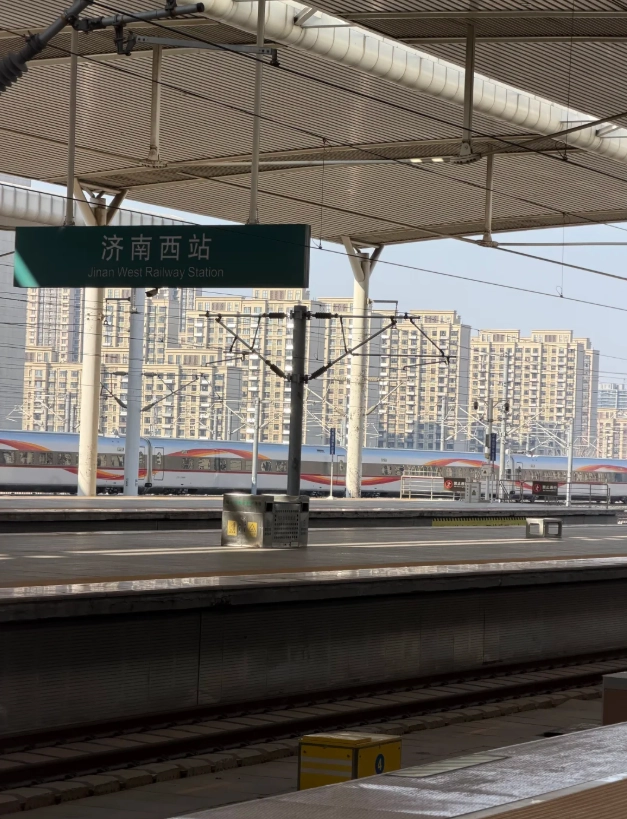
Jump to What You Need
What Is the Beijing to Shandong High Speed Train, Exactly?
The Beijing to Shandong high speed train is not a single service. It is a family of G and D trains that leave Beijing South and fan out across Shandong on three connected lines. Knowing which line you are on tells you which city you can actually reach in a morning.
The Four Lines That Actually Matter
The Beijing–Shanghai High Speed Railway is your spine for southern Shandong. It runs Beijing South, then Jinan West, then Tai'an, then Qufu East, then onward toward Xuzhou and Nanjing. If you want Mount Tai or the Confucius sites, you are on this line and you barely have to think.
The Jinan–Qingdao High Speed Railway handles the coast. From Jinan West it swings east through Zibo North, Weifang North, Qingdao North and finally Qingdao. Many Beijing departures run through both lines, which is how you get a direct train from Beijing to the Qingdao old town without changing anywhere.
The Qingdao–Yantai–Weihai intercity line extends further up the peninsula. Useful if you are chasing seafood and quieter coastline, but add two hours to your planning.
The old Beijing–Shanghai conventional line still exists and is much slower. Trains from Beijing Station take roughly double the time for a lower fare. I only recommend it if you specifically want an overnight sleeper and have time to burn.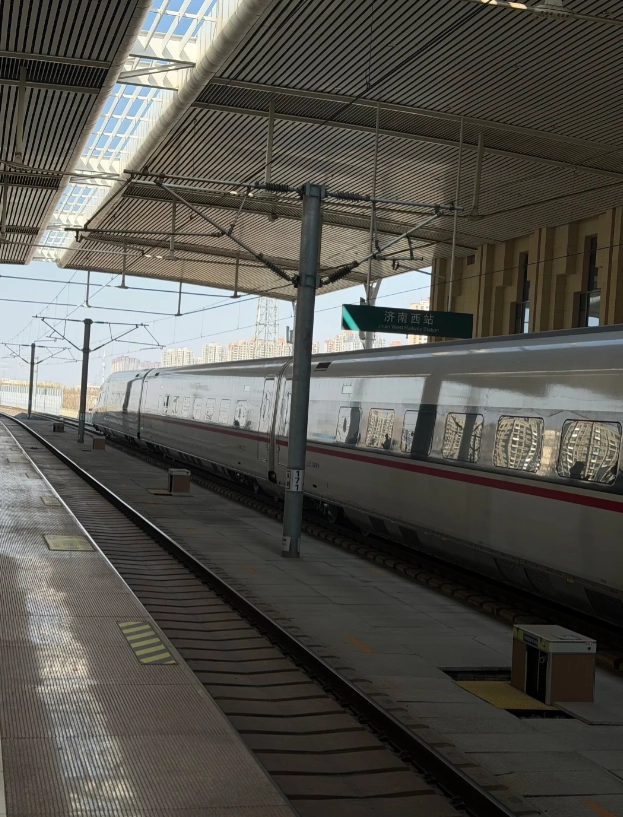
How Long Does Each Leg Take?
| Route from Beijing South | Fastest Journey | Approx. Second-Class Fare | Best For |
|---|---|---|---|
| Jinan West | 1h 20m to 1h 50m | RMB 185 to 220 | Springs, Baotu Spring, onward connection to the coast |
| Tai'an | 2h to 2h 30m | RMB 230 to 270 | Mount Tai day trip or overnight climb |
| Qufu East | 2h 10m to 2h 50m | RMB 280 to 320 | Temple and Cemetery of Confucius, Kong Family Mansion |
| Zibo North | 3h to 3h 30m | RMB 250 to 300 | Zibo barbecue, ceramic museums |
| Qingdao North or Qingdao | 4h 30m to 5h 30m | RMB 310 to 380 | Old German concession, beer, Zhanqiao Pier |
| Yantai | 5h 30m to 6h 30m | RMB 400 to 470 | Quiet coastline, wine region, ferry to Dalian |
Fares move with demand and train type, so treat those numbers as a budget guide and check live pricing on the official China Railway 12306 booking platform before you commit. What the table cannot show you is that the 1h 20m services are almost always early-morning departures with the worst seats, while the comfortable 1h 45m mid-morning trains are the ones locals actually book.
How Do You Book a Beijing to Shandong High Speed Train Ticket as a Foreigner?
Short answer: use the app, not the counter. The counter works, but you will queue behind a hundred people who all understand the system better than you do.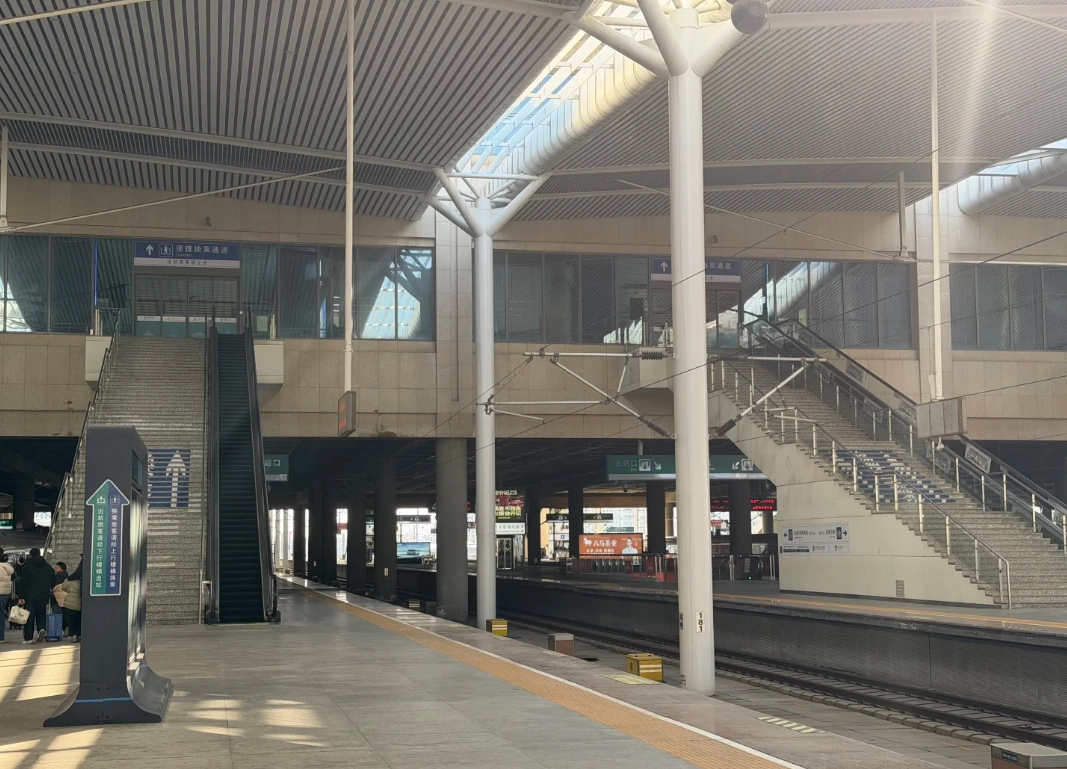
12306, Trip.com, or the Station Counter?
| Booking Channel | Foreign Card Accepted | English Interface | Extra Fees | My Honest Take |
|---|---|---|---|---|
| 12306 official app or website | Yes, Visa and Mastercard now work | Yes, there is a full English version | None | Cheapest and most reliable, but passport registration is fiddly |
| Trip.com | Yes | Yes | Small service fee per ticket | Best choice if this is your first China trip |
| Alipay train mini-program | Yes | Partial | None | Fast if Alipay is already linked to your card |
| Station ticket counter | Cash and Chinese payment apps | Limited | None | Backup only, for same-day changes and problems |
Passport Rules and Seat Classes Explained
Your passport is the ticket. Since e-ticketing became standard, there is nothing to print and nothing to collect. You tap or scan the passport photo page at the gate. Some stations have automatic gates that read foreign passports; others do not, and you join the staffed lane. Budget an extra five minutes for that.
Seat classes are simple enough:
- Second Class is a 3+2 layout and perfectly comfortable for a two-hour hop. For the long Qingdao run, book early to get a window.
- First Class is 2+2 with more legroom and a quieter cabin. Worth it on the four-to-five-hour legs, hard to justify on the Jinan sprint.
- Business Class is a lie-flat pod at roughly three times the price. Great on a long-haul, silly on a 90-minute ride.
- Standing tickets exist on busy days. They are cheap and genuinely unpleasant for anything over an hour. Avoid.
One more thing about identity. China's National Immigration Administration sets the entry and visa rules, and your passport number must match your booking exactly. A single wrong digit and the gate will not open, and the fix happens at a ticket window, not at the gate.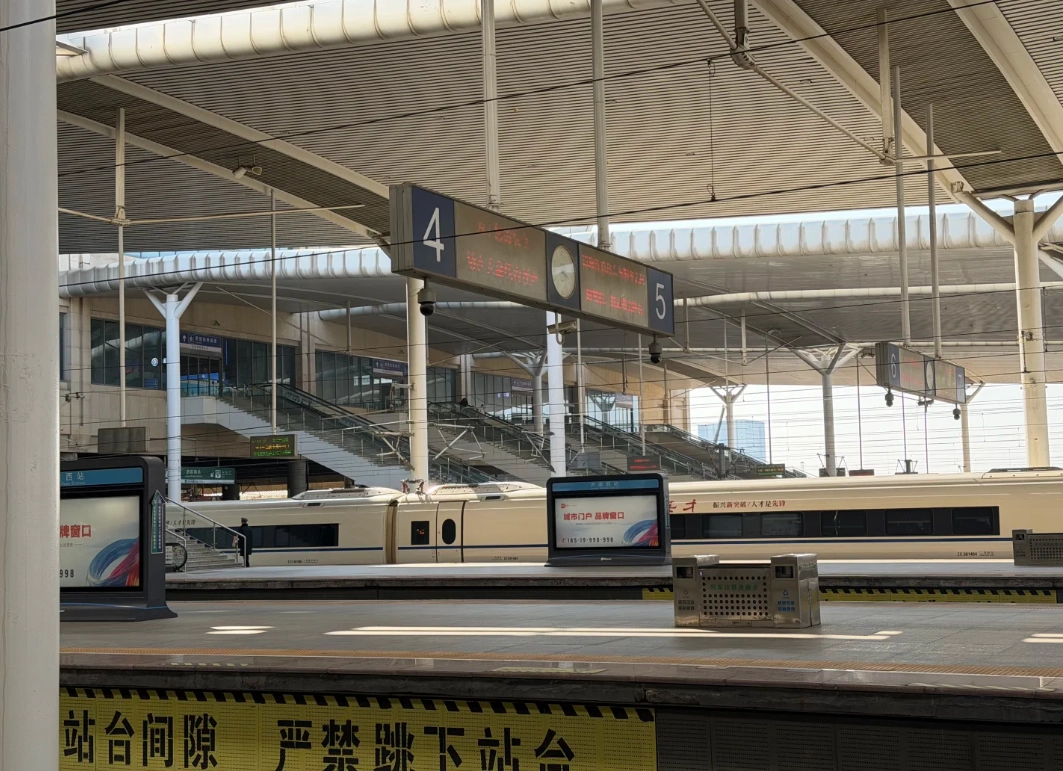
Pro Tip: Ticket sales open roughly 15 days before departure, and the release time differs from station to station. Set an alarm for the evening before the window opens, refresh the app at midnight, and buy then. Around Spring Festival, the first week of May and the first week of October, Beijing-to-Shandong seats on popular morning departures vanish within minutes.
Beijing South Station Without the Panic
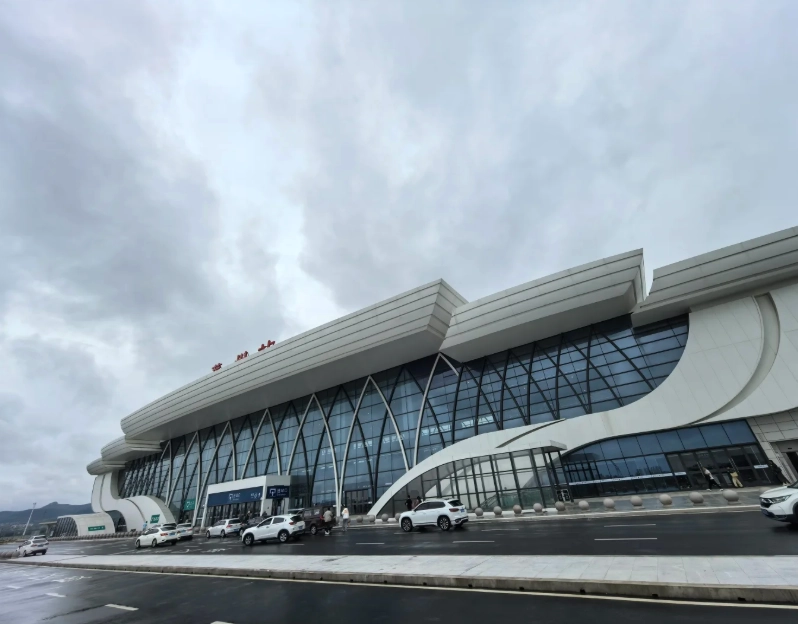
Beijing South Railway Station sits at No. 12 Yongwai Avenue in Fengtai District, and it is enormous. The English address you want on your phone is: Beijing South Railway Station, Yongwai Avenue, Fengtai District. Show that to a driver and you are fine.
Subway, Taxi, or Didi?
Before 7 AM, take a taxi or a Didi. After 7 AM, take the subway. That is the rule I give everyone. The station is served by Beijing Metro Line 4 and Line 14, and the metro entrance feeds directly into the station concourse, which means no traffic, no drop-off chaos and no arguments with a driver about which ramp to use.
If you are coming from a hostel in the Gulou or Dongcheng area, a Didi before dawn takes around 25 minutes and costs roughly RMB 50 to 70. The same trip at 8 AM can take an hour. The metro takes about 40 minutes door to door and costs a few yuan.
Google Maps is unreliable inside mainland China and will happily route you to a service road. Use Apple Maps, or install Amap and switch it to English mode. Your hotel receptionist can also drop a pin for you, which is often faster than typing an address.
The 60-Minute Rule, and When I Break It
Arrive 60 minutes before departure. I break that rule only for late-evening trains on weekdays, when the security line is nearly empty.
Here is the sequence, and it is not obvious. You enter the departures hall and pass through a security check — bags on the belt, water bottles out. Then you look up at the giant board for your train number and gate. Then you queue at the gate itself, where staff scan your passport. Then you go down to the platform. Four separate steps, and each one can back up.
The security line is the real bottleneck. Between 10 AM and 2 PM it snakes across the hall, and there is no fast lane for foreigners. My clients who have missed trains have almost all missed them at security, not at the gate.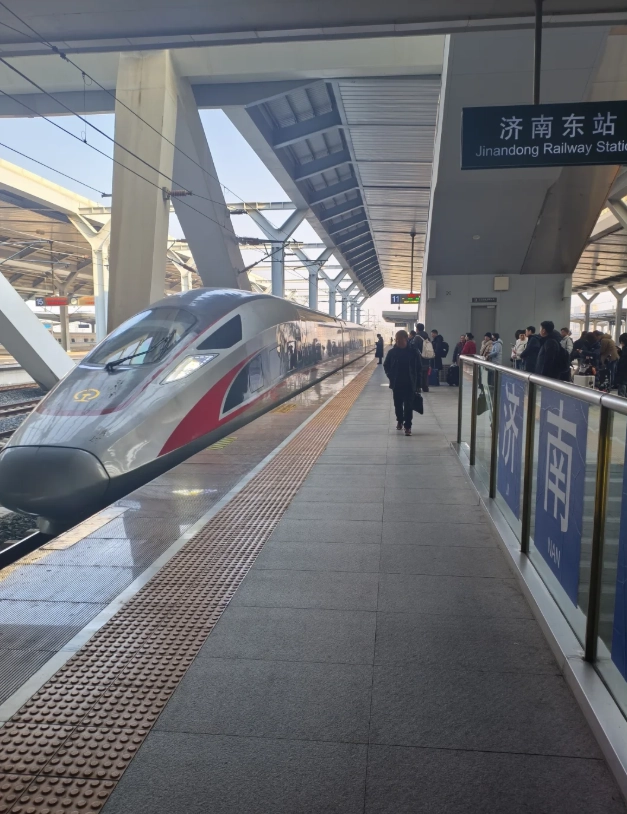
Insider Advice: The toilets beside the main ticket hall on the ground floor are the busiest in the building. Walk up to the second-floor food court instead — the washrooms there are quieter and the noodle shops are only slightly overpriced rather than outrageous. Eat before security if you can; the concourse-side options are better value.
Where to Get Off: Jinan, Tai'an, Qufu, and Qingdao Compared
This is the part nobody warns you about. Every city on the Beijing to Shandong high speed train line has a modern HSR station on the outskirts and an older station near the centre. They are not the same place.
| HSR Station | Distance to Main Sight | Transfer Time | Approx. Cost | The Trap |
|---|---|---|---|---|
| Tai'an | About 10 km to the Red Gate trailhead | 20 to 25 min by taxi | RMB 25 to 35 | Not the same as Taishan Station, which is closer but serves slower trains |
| Qufu East | About 10 km to the Temple of Confucius | 20 min by taxi, 30 to 40 min by bus | RMB 25 to 35 by taxi | Almost nothing to eat or do around the station itself |
| Jinan West | About 14 km to Quancheng Square | 30 to 45 min by taxi | RMB 40 to 60 | Not the same as Jinan Station, which is central |
| Qingdao North | About 15 km to the old town | 35 to 45 min by Metro Line 3 | Under RMB 10 by metro | Fine for the city, wrong for Zhanqiao Pier |
| Qingdao | Walking distance to Zhanqiao Pier | 5 to 10 min on foot | Nothing | Sells out first, especially on Fridays |
The Station-Name Trap That Costs Tourists an Hour
If your booking says Jinan and you wanted Jinan West, or the reverse, you are going to the wrong side of the city. The high speed line stops at Jinan West. The old downtown station, Jinan Station, serves conventional trains and a handful of slower services. They are roughly twenty kilometres apart, which is a 40-minute taxi in traffic.
The same confusion exists in Qingdao. Qingdao Station is right at the edge of the old German concession — you step out and you can see the pier. Qingdao North is a huge modern interchange out in the northern suburbs. Both are called Qingdao on some booking screens. Read the full station name, every time.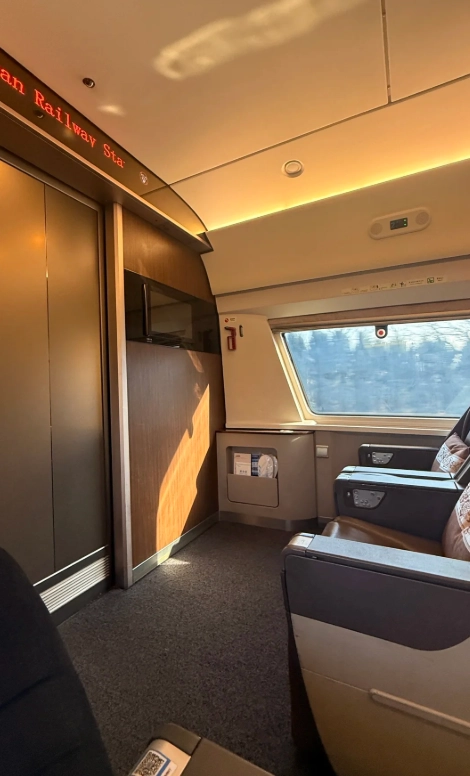
Mount Tai from Tai'an Station: The Route That Works
Mount Tai holds a UNESCO World Heritage listing and it is the reason most people add a Shandong stop at all. From Tai'an Station, a taxi to the Red Gate takes about 20 minutes. Do not walk it.
Start climbing by 8 AM if you want the summit before the tour groups arrive. The classic route is the Red Gate stone staircase, roughly 6,600 steps to the top, four to six hours up depending on your legs. Most visitors take the bus to the Midway Gate of Heaven and the cable car from there, which turns it into a manageable half day.
Two things I tell everyone. First, the temperature at the summit runs eight to ten degrees colder than the base, and the wind is brutal — rent a coat at the top rather than carrying one up. Second, if you want the famous sunrise, you are looking at an overnight climb or a very expensive hotel bed at the summit. Check the official ticket channels for current pricing and opening hours, because Mount Tai uses timed entry on busy dates and reservations go through passport-linked booking systems.
Qufu East to the Confucius Temple
Qufu East Station is in the middle of farmland, so plan your onward transport before you arrive. Taxis wait at the rank outside, and the ride to the Temple of Confucius takes about 20 minutes. There is also a local bus from the station forecourt into the old town, slower but cheap.
The three Confucius sites — the Temple, the Kong Family Mansion and the Cemetery — sit inside a compact old town you can walk in a day. A combined ticket covers all three, and you will need your passport to buy it. The cemetery is the one people skip, and it is a mistake: the forest of ancient cypresses there is quieter and stranger than anything in the temple complex.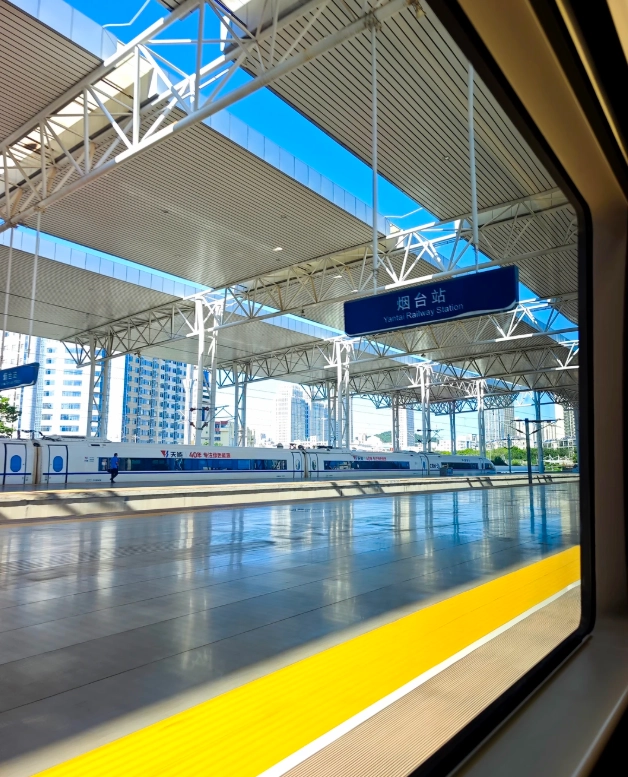
Qingdao: Two Stations, One Right Answer
Book to Qingdao Station if you can get it. You walk out of the exit, ten minutes later you are standing on Zhanqiao Pier with the sea in front of you. If only Qingdao North is available, take Metro Line 3 straight to the old town — the ride is about 40 minutes and costs almost nothing.
Seats, Food, Luggage and Power On Board
Picking the Right Seat
In Second Class, A and F are the window seats. In a 3+2 layout that means the seat letters run A, B, C on one side and D, F on the other — there is no E. If you are travelling as a pair, book D and F for a window plus aisle on the two-seat side, which is far more comfortable than the three-seat bench.
Power sockets sit under the seat in front of you or between the seat backs. They take the Chinese two-flat-pin plug, so bring a universal adapter. The onboard Wi-Fi is nominally free and practically useless once the train picks up speed. Buy a data eSIM before you fly instead.
What to Eat on a Beijing to Shandong High Speed Train
The dining car on a two-hour run is basically a counter with instant noodles, a couple of rice boxes and warm beer. It is not a restaurant. On the longer Qingdao legs it improves slightly, but not enough to plan around.
Here is the trick most visitors never discover: the 12306 app lets you order takeaway from restaurants at the stations along the route, and a staff member delivers it to your seat at the platform stop. You choose the restaurant, pay in the app, and the food arrives hot. It is genuinely one of the best-kept conveniences in Chinese rail travel. It only works on trains that stop long enough, so check the schedule when you order.
If you would rather keep it simple, buy food before you board. Beijing South has a decent food court upstairs. Just remember you cannot bring liquids through security in an open container without tasting them, so buy drinks after the checkpoint.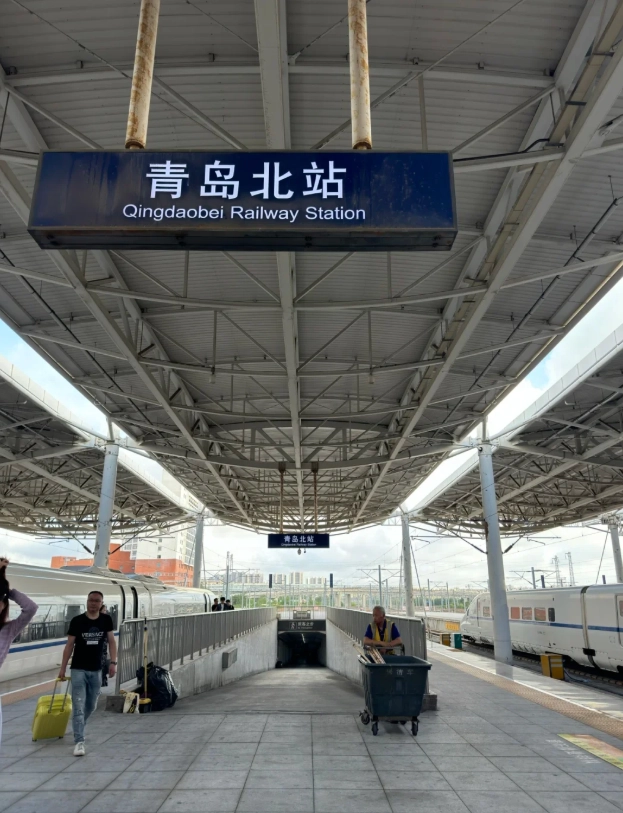
Luggage Reality Check
- There is no formal weighing of bags on high speed trains, but the nominal adult allowance is around 20 kg.
- Oversized suitcases go in the racks at the end of each carriage. They fill up fast on morning departures.
- Liquids, aerosols and power banks are checked at security. Power banks above the permitted capacity get confiscated.
- Bicycles and large sporting equipment need advance arrangement and are often refused at the gate.
Five Mistakes That Ruin This Trip
I have watched every one of these happen to real people, usually in the same week.
- Booking by city name instead of station name. Jinan and Jinan West, Qingdao and Qingdao North. This single error causes more missed connections than anything else.
- Arriving 25 minutes early because the train ride is only 90 minutes. The ride is short. The station process is not. Sixty minutes, every time.
- Assuming you can tap a foreign credit card at the gate. You cannot. Your passport is the key, and the staffed lane is your friend.
- Buying the ticket the day you want to travel. On a Tuesday in March you might get lucky. On a Friday in October you will be standing in the aisle for two hours.
- Trusting Google Maps for the walk to your hotel. It is frequently wrong inside China. Use Apple Maps or Amap and screenshot the route before you leave the station.
One thing I will admit is genuinely annoying: registering a foreign passport on the 12306 app involves a verification step that sometimes rejects perfectly valid documents, and the error messages are not always translated well. If it fails twice, stop fighting it. Ask your hotel receptionist to book on their account, or just pay the small fee on Trip.com. Losing an hour to a stubborn app is not how you want to spend your first morning in China.
Beijing to Shandong High Speed Train FAQ
Can I buy a Beijing to Shandong high speed train ticket at the station on the same day?
You can, and it works more often than people expect outside holiday periods. The catch is that same-day seats are whatever has not sold, which means middle seats in the three-bench row or standing tickets on busy corridors. If your schedule is fixed, book the moment the 15-day window opens and skip the gamble entirely.
I missed my Beijing to Shandong high speed train. Is the ticket worthless?
Not worthless, but not free either. Go straight to a ticket window or open the app and change to a later departure the same day. Whether a fee applies depends on how close to departure you made the change and what seats remain. Standing in the departure hall complaining will not help — the change has to be processed through the system.
Do I need to print a paper ticket for the Beijing to Shandong high speed train?
No. Paper tickets are effectively gone for high speed rail. Your passport is scanned at the gate and that is your boarding authority. The only reason to visit a window is if you need a formal reimbursement receipt, and even that is optional for most travellers.
Is Beijing South the only station with trains to Shandong?
Beijing South handles essentially all of the fast services, so if you want a 90-minute run to Jinan West, that is your station. Beijing Station runs slower conventional trains on the older line, and Beijing West serves a different corridor entirely. Double-check which Beijing station your train number departs from, because the city has several and they are not close to each other.
How do I pay for things once I am on the train and in Shandong?
Link your international card to Alipay or WeChat Pay before you fly and you will cover almost everything, including the onboard food cart. Physical foreign credit cards are accepted at large hotels and nowhere else. Keep a few hundred yuan in cash for taxis at rural stations like Qufu East, where the driver may not have a working QR code reader.
Verified and fact-checked by the editorial team. This content has been fact-checked to ensure informational precision.

No comments yet.