 Bo Wu
Bo Wu
Quick Takeaways
You booked a flight from London to Bangkok with a 72-hour layover in Shanghai. Then you think: “Can I hop over to Hangzhou for a day? Or even Beijing?” That's the million-dollar question.
Let me save you the headache. I've been guiding travelers through China's visa-free transit rules for years, and I've seen people get denied boarding because they assumed they could roam freely. Here's the short answer: Yes, you can travel across provinces—but only under specific conditions. And the conditions are trickier than most blogs tell you.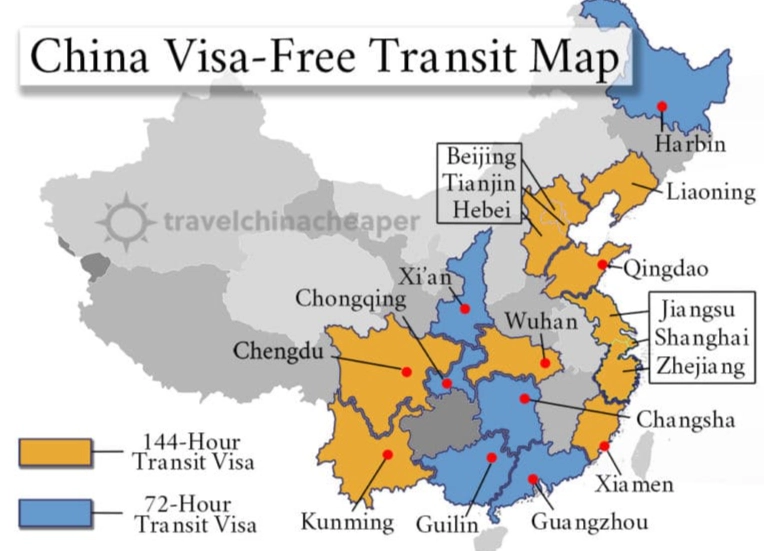
The Basics: What's Allowed?
China's visa-free transit (also called TWOV – Transit Without Visa) allows passport holders from 53+ countries to stay in certain cities for 24, 72, or 144 hours without a visa, provided they have a confirmed onward ticket to a third country. The catch? You're not free to travel anywhere in China. You're confined to a specific geographic area.
Hard truth: Most 72-hour TWOV policies restrict you to the same city or its metropolitan area. 144-hour policies often allow travel within a whole province or a designated region (like the Yangtze River Delta). But crossing provinces is a different beast.
Here's the key: the permission depends on the policy type and the port of entry. I'll break it down in the next section.
24h, 72h, 144h – Which One Lets You Cross Provinces?
Not all transit policies are created equal. Let's map them:
| Policy | Allowed Area | Can You Cross Provinces? | Example |
|---|---|---|---|
| 24-hour transit | Within the same city (port city) | No | Arrive in Shanghai, you can't go to Suzhou (Jiangsu) |
| 72-hour transit | Strictly the same city (with few exceptions) | Generally no | Beijing 72h: only Beijing municipality |
| 144-hour transit (Guangdong) | Entire Guangdong province | Yes, but only within Guangdong | Arrive in Guangzhou, can go to Shenzhen or Zhuhai |
| 144-hour transit (Shanghai, Jiangsu, Zhejiang) | Shanghai + Jiangsu + Zhejiang (cross-province allowed) | Yes (within the delta) | Arrive in Shanghai, you can visit Hangzhou (Zhejiang) and Nanjing (Jiangsu) |
| 144-hour transit (Beijing, Tianjin, Hebei) | Beijing + Tianjin + Hebei (cross-province allowed) | Yes (within the region) | Arrive in Beijing, you can go to Tianjin |
| 144-hour transit (Chengdu, Chongqing) | Chengdu + other cities in Sichuan, or Chongqing municipality | Yes (within Sichuan/Chongqing) | Arrive in Chengdu, can visit Leshan (same province) |
So the only policies that allow cross-province travel are the 144-hour ones that specifically bundle multiple provinces or an entire province. The 72-hour and 24-hour policies keep you locked in one city.
My tip: if you want to see more than one city, aim for a 144-hour transit in the Yangtze River Delta (Shanghai + Jiangsu + Zhejiang). It's the most flexible for foreign travelers.
The Real Loophole: Domestic Flights & Port Hopping
Here's something many guides miss: you can sometimes piece together multiple transit periods if you re-enter from a different port. But it's risky. Let me walk through a real scenario.
Imagine you fly London → Shanghai (72h transit), stay two days, then fly Shanghai → Beijing (domestic), and then Beijing → Tokyo. The problem: domestic flights within China are treated as separate “entries” by immigration. When you land in Beijing, you'll need a visa or another transit policy. Beijing's 144-hour policy applies only if you arrive directly from abroad, not from another Chinese city. So you'd be stuck.
Here's the catch: You cannot chain transit periods by flying domestically. Once you leave the transit area (by taking a domestic flight), you've ended your initial transit. You must exit China and re-enter from abroad to start a new one.
But there is a workaround for the 144-hour bundled regions. For example: fly into Shanghai Pudong, use the 144h Yangtze River Delta policy to visit both Shanghai and Nanjing (by high-speed rail, not domestic flight). Then exit from Shanghai to Tokyo. That works because you're staying within the designated region without leaving China.
Remember: high-speed rail is your friend. It's considered ground transport and doesn't break your transit status. But if you take a domestic flight from Shanghai to Nanjing, immigration might flag it as an internal departure. Stick to trains within the same policy zone.
Common Pitfalls & How to Avoid Them
Over the years, I've seen travelers make these mistakes:
- Assuming 72h allows province travel. It doesn't. I once had a client who booked a hotel in Suzhou thinking 72h in Shanghai allowed him to roam. He got turned away at the train station ticket check because his passport lacked a visa. Stick to the city limits.
- Using domestic flights to “hop” destinations. As I said, domestic flights end your transit. Always use high-speed rail if you need to move within a multi-city zone.
- Not having a printed onward ticket. Airlines will deny boarding if you can't show a confirmed ticket to a third country (not your home country). I've seen British travelers try to fly to Hong Kong — that's not a third country for China (it's a SAR). Must be a different country.
- Forgetting to register your stay. Hotels must report your passport to local police. If you stay in a private residence, you need to register at the local police station within 24 hours. Skipping this can cause issues when you leave.
Frequently Asked Questions
Fact-checked: This content has been fact-checked to ensure informational precision. Verified against official Chinese immigration announcements and recent traveler reports.






No comments yet.