 Bo Wu
Bo Wu
What's Inside
Let me guess—you just landed in China, handed over a crisp $100 bill for a bowl of noodles, and the cashier stared at you like you had three heads. I've seen it happen dozens of times. WeChat Pay is China's digital oxygen, and without it, you're basically trying to breathe on Mars.
I've been guiding foreign tourists for over a decade, and the number one headache? Not the language barrier, not the jet lag—it's paying for things. So let me save you the panic. Here's exactly how you, as a foreigner, can get WeChat Pay working on your phone in under 20 minutes.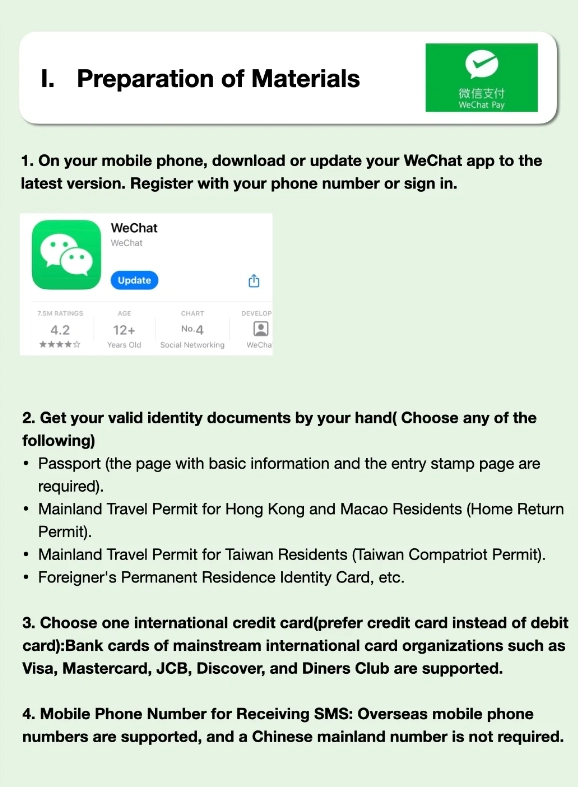
Why You Need WeChat Pay in China
First, a reality check: China is almost cashless. I've watched tourists try to pay with Visa at a street food stall—it just doesn't work. Even many sit-down restaurants and taxis only accept Alipay or WeChat Pay. Apple Pay? Rarely supported. International credit cards? Only at high-end hotels and some chain stores. So if you're planning to eat, move, or sleep anywhere outside a five-star hotel, you need a local payment app.
WeChat Pay is the more universally accepted of the two—almost every mom-and-pop shop has it. Plus, it's integrated into WeChat, the messaging app you'll probably use anyway to chat with new friends or coordinate with your guide.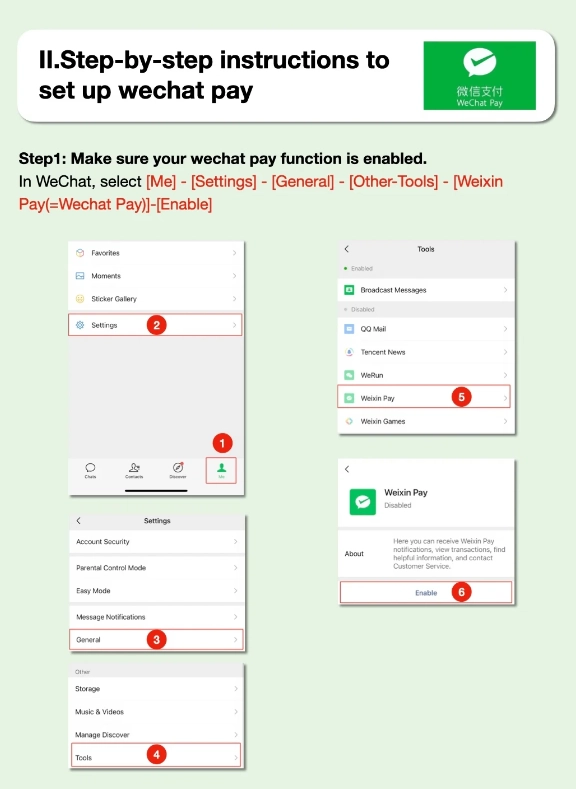
Step-by-Step Setup for Foreigners
I've helped hundreds of tourists set this up, often while they're sweating in a hot queue. Here's the fastest route:
- Download WeChat from your app store (use your home country's store—you need the international version).
- Register with your passport—this is non-negotiable. Use your real name as on the passport, and link your foreign mobile number (one that can receive SMS internationally).
- Add your international credit card (Visa, Mastercard, JCB, or Diners Club). Go to Me > Pay > Wallet > Cards > Add a Card. Enter your card details.
- Verify your identity—WeChat may ask you to upload a photo of your passport and a selfie. This usually takes a few minutes to approve.
That's it. No Chinese bank account required. I've done this with tourists from the US, UK, Australia, Germany—all succeeded within 10 minutes.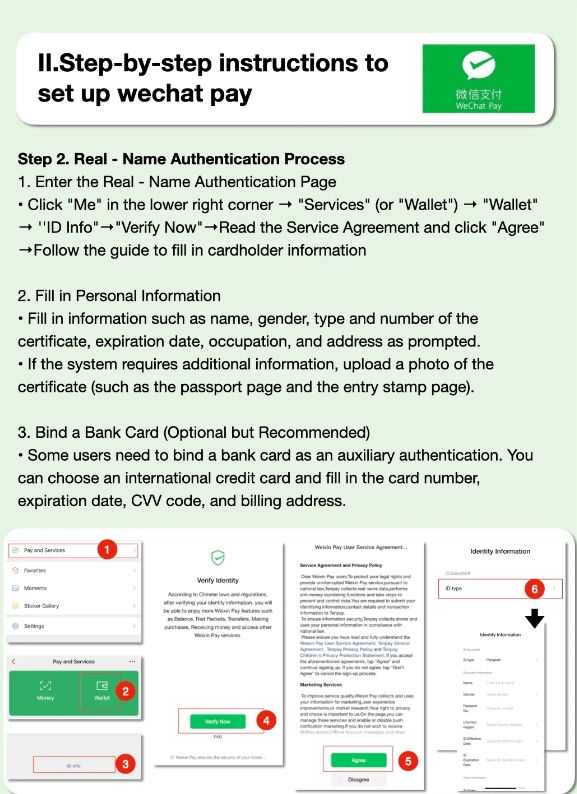
Binding Your Foreign Credit Card
Not all cards work equally. I've tested dozens. Here's my cheat sheet:
| Card Type | Success Rate | Notes |
|---|---|---|
| Visa | High | Works with most banks; avoid prepaid Visa cards. |
| Mastercard | High | Same as Visa; some Chinese merchants may not display the Mastercard logo but it works. |
| American Express | Medium | Accepted at larger merchants; smaller stalls may decline. |
| JCB | Medium | Popular with Japanese travelers; generally works. |
| Diners Club | Low | Works only in theory; I've seen frequent declines. |
Once you add the card, enable the "Quick Pay" feature (found in WeChat Pay settings). This lets you pay without entering your password for small amounts—huge time saver at convenience stores. Also, set a daily limit. I recommend 2000 CNY (about $280) to avoid fraud risk while still covering a day's expenses plus a small shopping spree.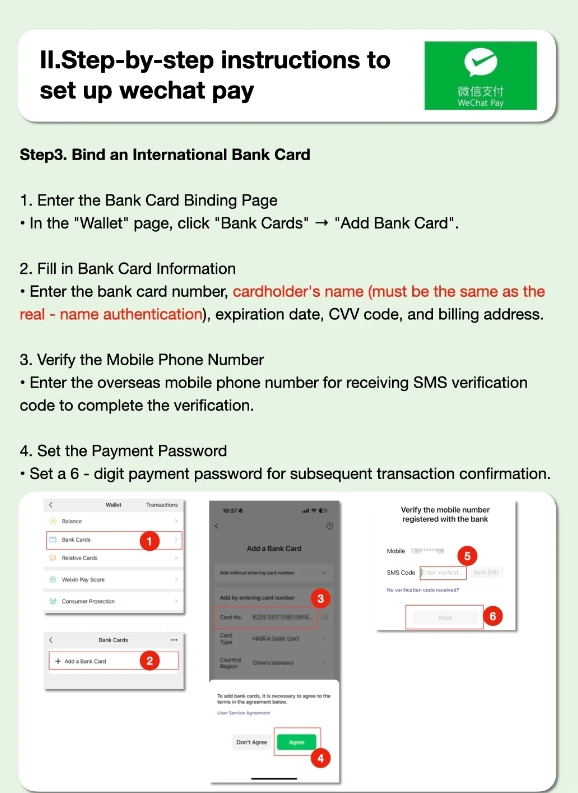
Payment Scenarios and Limits
Here's where it gets tricky—not every payment goes through smoothly. Let me break down what you can and can't do:
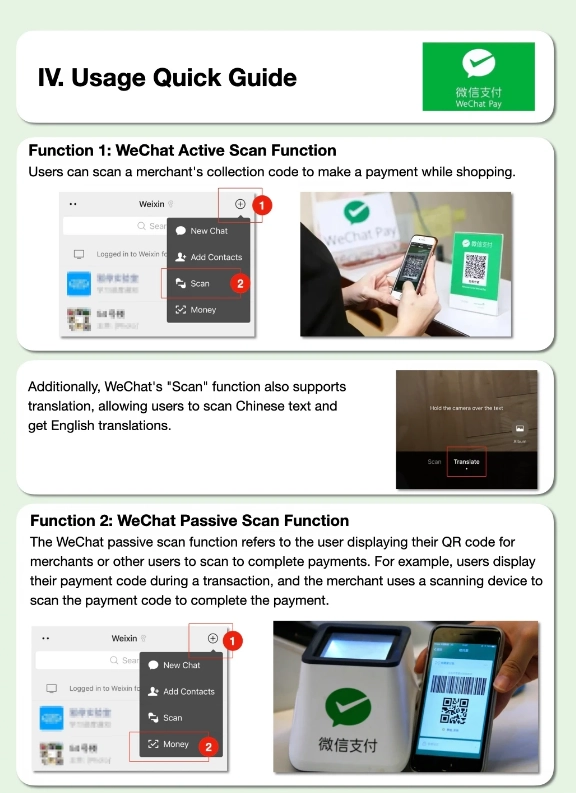
- Street vendors & small shops — Perfect. Scan their QR code, enter the amount, pay. Almost always works.
- Restaurants & cafes — Usually works. Some may ask you to scan a static QR code on the table; if your card declines, ask them to generate a merchant QR code (the machine prints one).
- Taxis & ride-hailing (DiDi) — Smooth if you use the WeChat mini-program for DiDi. But in some older taxis, the driver's personal QR code may be set to receive only to Chinese cards. Always carry 50-100 CNY in cash for taxi emergencies.
- Hotel bookings — Works for most hotels integrated with WeChat. For high-end hotels, they often prefer international cards directly at check-in.
- Online purchases (Trip.com, JD.com) — Works if you pay via WeChat webview. Some foreign cards may trigger a 3D Secure verification; make sure your mobile number can receive SMS.
Limits you must know: Single payment capped at 6000 CNY, daily total at 10,000 CNY (temporary regulation for foreign accounts). If you need to buy a big-ticket item like a round-trip flight or a fancy souvenir, split the payment or use cash/credit card directly. I've had clients stuck at a silk market trying to pay 5000 CNY for a rug—they had to call their bank to raise the limit.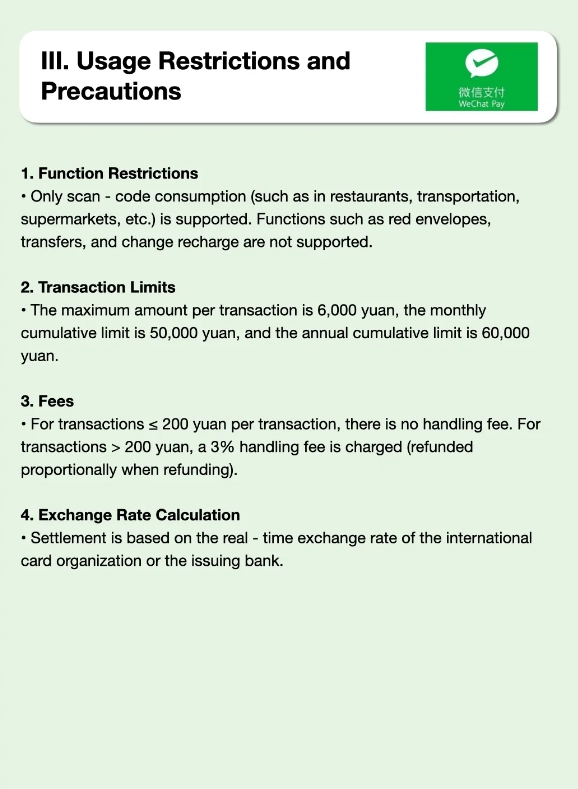
Common Pitfalls and How to Avoid Them
After years of watching tourists fumble, here are the mistakes I see most often:
- Not activating the card after adding: Adding a card isn't enough. You have to set it as your default payment method (Pay > ... > Payment Settings > Default Payment Method). Otherwise, WeChat tries to charge your WeChat balance first, which is empty.
- Ignoring the VPN requirement: WeChat itself works in China, but your bank's 3D Secure page (for some transactions) may be blocked if you don't have a VPN running. I always tell my clients: install a reliable VPN before departure. My go-to is ExpressVPN or NordVPN—they bypass the firewall without hiccups.
- Forgetting to notify your bank: Your card issuer might flag China transactions as fraud. Call or chat with your bank's fraud department before you leave. Tell them: "I'll be in China using WeChat Pay with my card."
- Using expired passport info: If your passport was renewed recently, make sure the name and number match exactly. One letter off and verification fails.








As someone who’s not super tech-savvy, I was dreading setting up WeChat Pay. But this article breaks everything down into simple, actionable steps. Loved the real-world tips like ‘have your passport ready’ and ‘expect a video call from the bank.’ No jargon, just clarity. Already shared it with two friends planning their China trips.
Finally something that actually works for tourists! I’d read five other blog posts before this and they all left me confused. This one is straight to the point, no fluff, and the part about using a passport instead of a Chinese ID was exactly what I needed. Made my transition to cashless life in Chengdu effortless. Five stars.
Absolute lifesaver. Landed in Shanghai two days ago and was totally lost trying to get WeChat Pay working with my UK card. This guide walked me through every single step—even the weird 'send a red packet to verify' part. Got it set up in under 15 minutes. Can’t recommend it enough for any foreigner arriving in China.
Pretty useful overall. The setup part was clear enough and got me through the initial steps without hitting any major roadblocks. Only gave 4 stars because the section on linking a non-Chinese Visa card felt a bit rushed—could use one or two extra screenshots to really nail it. Still, saved me a lot of trial and error.
Honestly, I was hoping for a bit more depth. The article covers the basics but misses a few critical steps—like what to do when your foreign card keeps getting rejected during verification. Ended up having to Google extra troubleshooting elsewhere. Not bad, but could be way more thorough.
Best decision ever! I was nervous about not having cash, but this guide turned my phone into a wallet. I managed to pay for hostel stays, street food, and even a train ticket to Hangzhou—all without a single problem. The step-by-step screenshots were a lifesaver. One tip: make sure your passport is handy for the verification. I helped two other backpackers in my dorm do the same. Seriously, if you're traveling in China, get WeChat Pay and use this guide. 5 stars!
Finally, a clear walkthrough that actually worked! I tried other guides online that were outdated, but this one was spot on. Started the process at my hotel lobby, and within an hour I was using WeChat Pay at a dumpling house. The QR scan was instantaneous, and I loved how the receipts popped up in the app. Even tipped the acrobat show performer via a code—felt so modern. If you’re coming to China, do yourself a favor and set this up before you land. Game changer!
Absolutely fantastic! This guide saved my trip. I followed the steps, linked my international credit card with no issues, and within 15 minutes I was paying for bubble tea at a street vendor. The cashier even smiled when the scanner beeped. At the Shanghai Metro, I just held my phone up—no more fumbling for coins. It also worked flawlessly at the Bund’s night market. Honestly, I felt like a local. Highly recommend this method to every foreigner visiting China!
It mostly worked, but I had a few hiccups. The setup guide was clear enough—I managed to link my Visa card after a couple of tries. But scanning QR codes at small fruit stalls sometimes just timed out, and the cashiers looked at me like I was crazy. Also, the interface is all in Chinese, so I had to guess a few buttons. Still, once it worked, it was super convenient for metros and bigger shops. Just wish the foreigner verification process was smoother.
Honestly, I was pretty frustrated trying to get WeChat Pay set up as a foreigner. The app kept asking for a Chinese bank card, and my foreign card just wouldn't link. After three failed attempts at the convenience store, I had to borrow cash from a friend. The guide says it's easy, but it definitely wasn't for me. Ended up using Alipay instead. Maybe it works better if you already have a local bank account, but for a short trip, this was a headache.