 Hui Lin
📌 Quick Navigator
First landing in China and your phone shows “No Service”? I've seen that panic on dozens of tourists' faces at baggage claim. Here is the thing: your home SIM will likely be useless—Google Maps won't load, WeChat Pay won't work, and you'll feel stranded. A China SIM card for tourists is the single most important purchase you'll make after your visa. Let me walk you through everything I've learned guiding groups over the years.
Bottom line up front: Get a prepaid SIM from China Mobile or China Unicom at the airport upon arrival. It's fast, cheap, and with the right plan you'll bypass the Great Firewall for most apps. Don't waste time hunting for deals in the city—airport counters are your friend.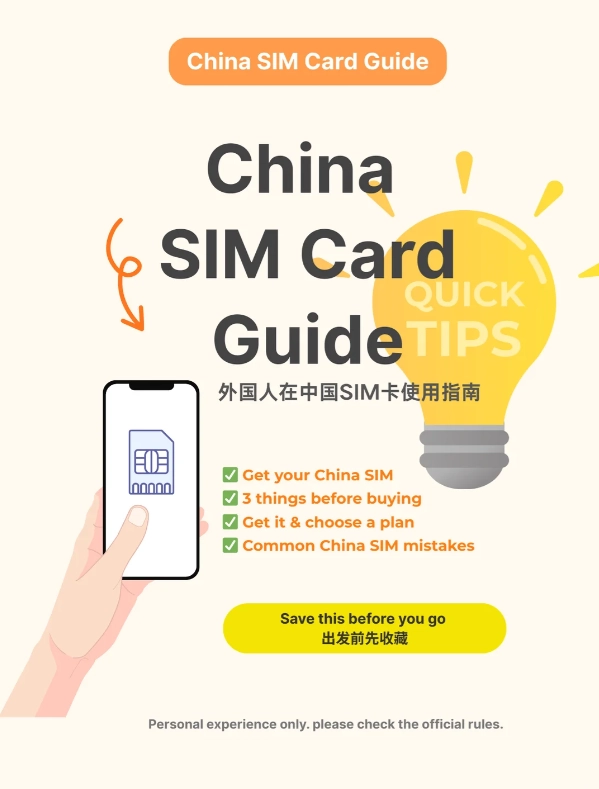
Why You Need a Local SIM
Roaming is expensive and slow. Even if your provider offers a global plan, latency is terrible and you'll be stuck with a foreign IP that Chinese services block. Without a local SIM, you can't:
- Use Didi (Chinese Uber) — essential for getting around
- Pay with Alipay or WeChat Pay linked to a Chinese number
- Book train tickets on 12306 (they send SMS verification)
- Navigate with reliable maps like Apple Maps or Amap
A China SIM gives you a local number, fast data, and usually includes a VPN-friendly data allowance (carriers like Unicom and Mobile offer plans that don't block VPNs as aggressively as China Telecom).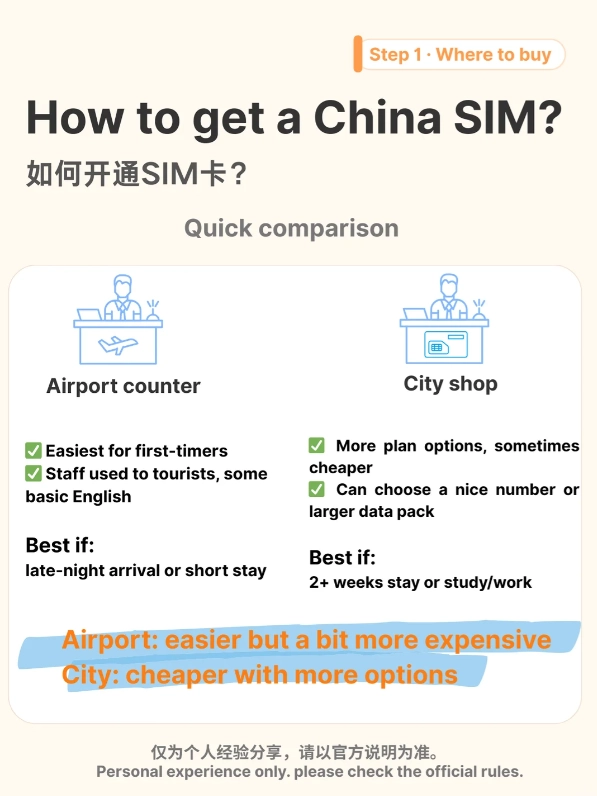
Where to Buy: Airport vs City
Buy at the airport — period. I've told countless travelers to wait and regret it. Here's why:
Airport Counters (Best Option)
Every major international airport has official carrier shops right after customs. Beijing Capital (PEK), Shanghai Pudong (PVG), Guangzhou Baiyun (CAN), Shenzhen Bao'an (SZX) all have China Mobile, China Unicom, and China Telecom kiosks. You'll need your passport. They'll handle registration (which is required by law). The whole process takes 10-15 minutes. Prices are transparent, and staff usually speak basic English.
Typical costs: A 7-day tourist SIM with 10-15GB data costs around 80-150 RMB (~$12-$20). Some include 30-60 minutes of local calls.
City Shops (If You Missed the Airport)
You can find carrier stores in downtown areas. Use Apple Maps to search “China Unicom business hall” or “China Mobile service center”. Be prepared for longer waits and potential language barriers. They'll ask for your passport and may require a local address (just give your hotel name). Avoid small electronics shops — they often sell overpriced or expired SIMs.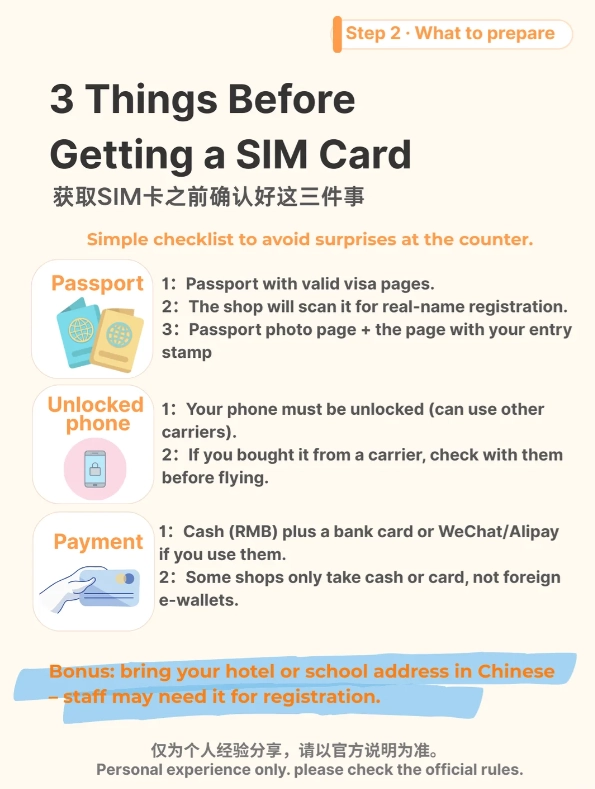
Top Carriers and Plans
Three main state-owned carriers dominate. Here's a quick comparison from my experience:
| Carrier | Coverage | Data Speed | VPN-friendly | Best for |
|---|---|---|---|---|
| China Mobile | Best in remote areas (Tibet, rural) | Good | Moderate (some VPNs work) | Travelers going off the beaten path |
| China Unicom | Excellent in cities and along rail lines | Very Good | Best (least VPN blocking) | City trips & digital nomads |
| China Telecom | Good in urban centers | Good | Weak (blocks many VPNs) | Basic calls & if you don't need VPN |
My recommendation: Go with China Unicom if you're mostly in cities and need reliable VPN access. If you're heading to the countryside, choose China Mobile. Avoid China Telecom unless you have a specific reason.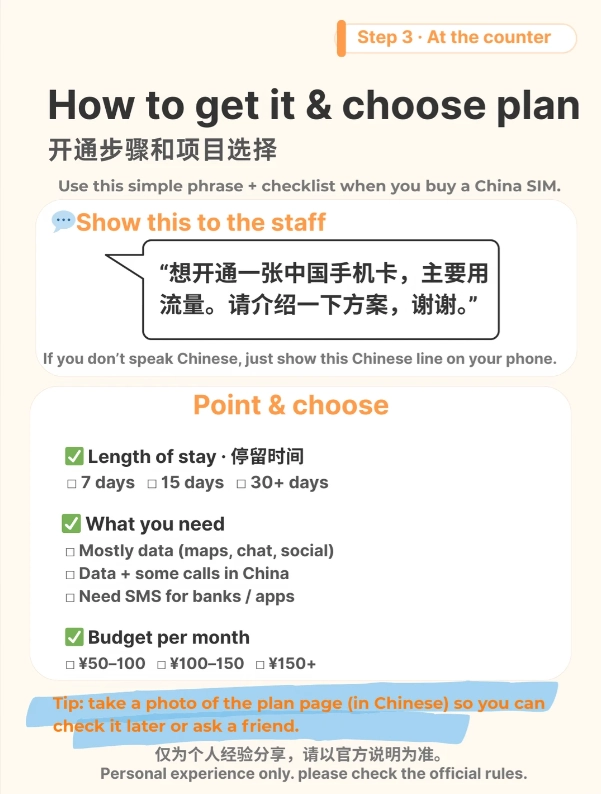
Tourist Plans (2025)
Most carriers now offer dedicated tourist SIMs. Ask for “旅游卡” (lǚyóu kǎ). For example, China Unicom's “Tourist Card” gives 15GB data + 30 mins calls for 128 RMB / 7 days. China Mobile has a similar plan for 100 RMB / 7 days with 10GB. Prices may vary by airport.
eSIM: The No-Swap Option
Don't want to swap your physical SIM? eSIM for China is now a real option. Many modern phones (iPhone SE2+, Google Pixel 4+, Samsung S20+) support eSIM. You can buy a data-only eSIM from providers like Airalo, Holafly, or Nomad before your trip.
- Pros: No need to find a store, instant activation, keep your home number active.
- Cons: Data only (no Chinese phone number), often more expensive per GB, and some eSIMs still get blocked by the firewall.
I'd only recommend eSIM if you already have a home number that's important and you don't mind paying a bit more. For most first-timers, a physical SIM is still the most reliable.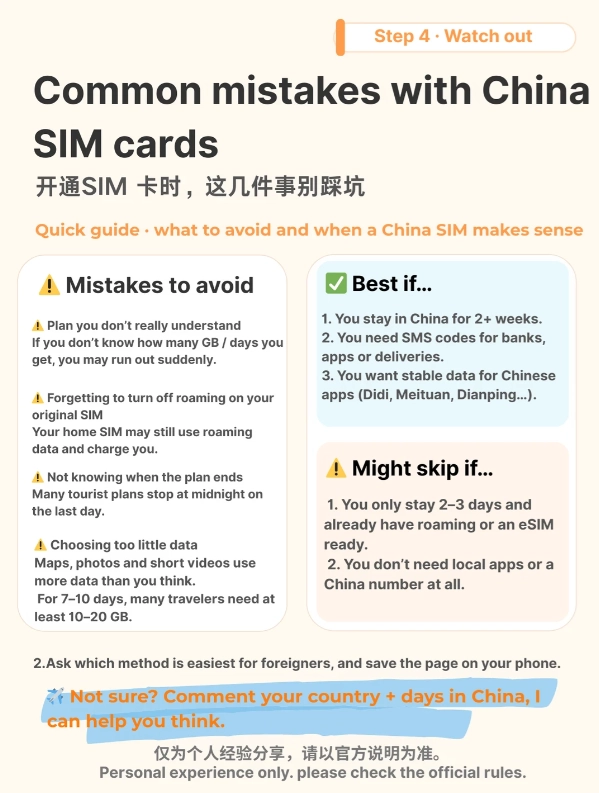
Activation Tips & Pitfalls
Now, let me save you the headaches I've seen travelers face:
Passport Registration is Mandatory
Chinese law requires real-name registration. You must present your physical passport (not a copy). The staff will scan it and take your photo. This takes about 5 minutes. Some airports now allow self-service kiosks with English instructions — use them if line is long.
Unlocking Your Phone at Home
If your phone is locked to a carrier (common in the US), you must unlock it before arriving. Contact your provider. Without unlocking, a Chinese SIM won't work.
Making Calls from Your Local SIM
Your Chinese number is 11 digits. To call internationally, dial 00 + country code + number. To call local, just dial the number. Pro tip: Add 10-20 RMB of credit for emergency calls — you might need to order Didi or call a hotel.
Topping Up
You can add credit at any convenience store (like 7-Eleven, FamilyMart) by showing your phone number. Or use Alipay if you have it set up. Most tourist plans are prepaid and won't need topping up for a short visit.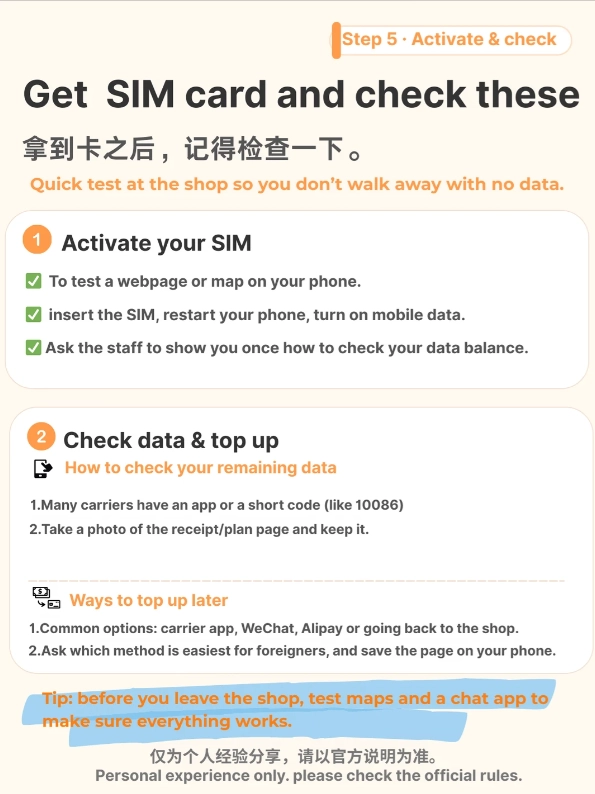
Frequently Asked Questions
Final Thoughts
Getting a China SIM card for tourists is not hard — the biggest mistake is overthinking it. Buy it at the airport, choose China Unicom or China Mobile, and install a VPN before you leave. Your trip will be 10x smoother when you can navigate, pay, and stay connected. Safe travels!
Verified and fact-checked by the editorial team.








This card felt like a warm blanket after a long flight. I usually get really anxious about connecting with family, but I had a video call with my mum outside the Great Wall and it held up perfectly. The little instructions showing how to set APN were a lifesaver because my phone didn't do it automatically. The only moment I choked up was losing reception in a remote valley—but even the local guide had none, so that's saying a lot. 10/10 would use again.
For the price, this thing is unbeatable. I paid less than one day of my old carrier's roaming and got 12 days of data. The instructions were super clear, with actual screenshots, and the card worked in Xi'an, Chengdu, and a random mountain village in Sichuan. I even shared my hotspot with a friend. No international plan will come close to this value. Definitely grab this before your trip.
I was literally dreading having no data in China, but this SIM card made it a non-issue. Landed in Shanghai, popped it in, and had 5G before I got through customs. I used it every day in Hangzhou and Suzhou, from Alipay at breakfast to DiDi rides late at night. The speed was surprisingly consistent even in crowded tourist spots like Yu Gardens. Can't recommend it enough if you want to skip the roaming nightmare.
Bought this to avoid my carrier's $15-a-day roaming and it paid off. Setup took less than two minutes in the arrivals hall of Beijing Daxing. Data was great for WeChat, maps, and ordering food. I didn't love that I couldn't access a few Western sites without a separate VPN, but that's not the card's fault. Customer service replied within five minutes when I asked about topping up. Four stars because the 4G speed in the subway stations was patchy at times.
Worked well enough in the city, but I hit a real dead zone on the train from Hangzhou to Huangshan and had to switch to offline maps. The card arrived pre-loaded, but the activation code on the packaging didn't match the one in the email. I got it sorted with WhatsApp support, but it took over an hour. If you're mostly staying in big cities, it's okay; just don't expect flawless coverage once you get rural.